
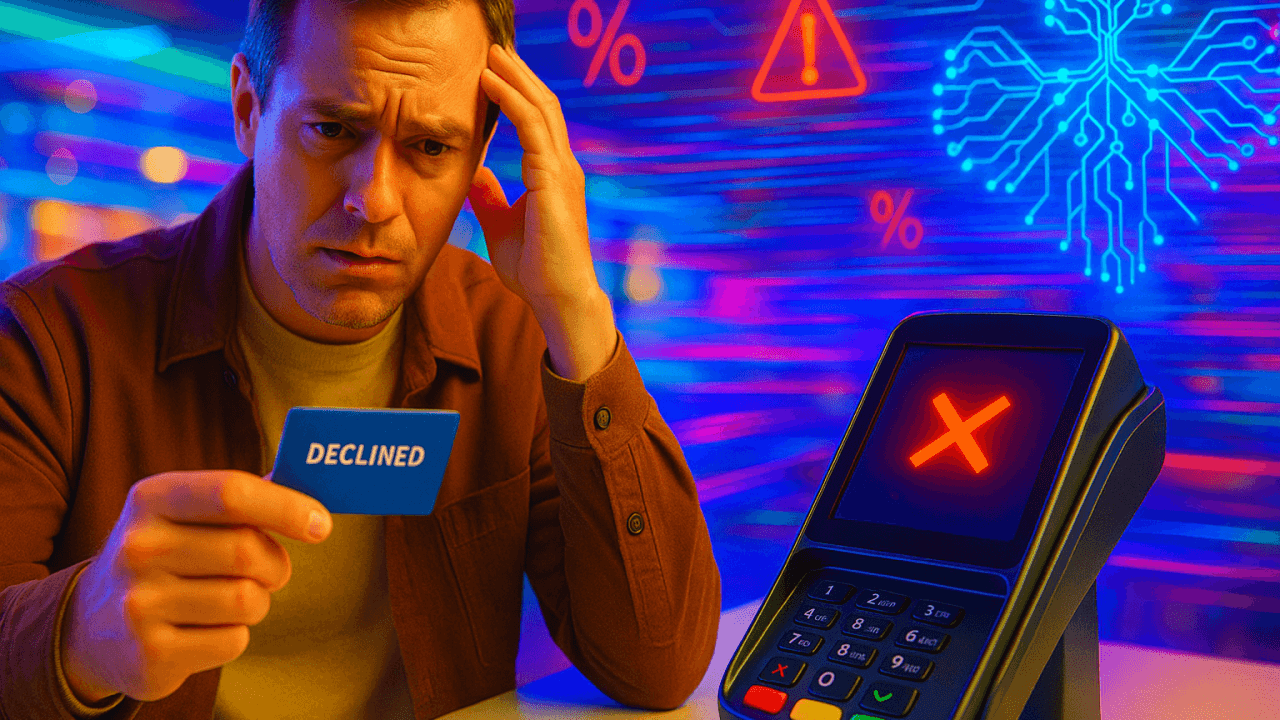
The Hidden Cost of Checkout: Why False Declines Are Taking a Bigger Toll Than Fraud
In the digital payments ecosystem, we tend to focus on detecting and reducing fraud. But there’s a quiet threat that often goes unnoticed and can have an even bigger impact: false declines.
A false decline happens when an overly strict fraud prevention system rejects a legitimate card transaction. Real customers are trying to pay, only to be wrongly blocked at the most critical moment: checkout.
According to a recent JP Morgan Payments report, fraud losses account for 7% of the total cost, while losses from false declines already account for 19%. A Worldpay study also found that 11% of online transactions in the United States are wrongly declined.
In other words, we’re losing more to overly strict safeguards than to actual attacks.
The problem: when protecting yourself gets expensive
Fraud filters designed to protect issuers and merchants have evolved, but in many cases they’ve also become more aggressive and less accurate. The immediate result is frustrated customers, lost sales, and a broken user experience.
The impact goes beyond the financial losses. An estimated 4 in 10 consumers won’t shop with a merchant again if it declines their payment without good reason.
At WAU, we’ve seen this with several of our clients. They invest heavily in customer acquisition, UX design, and promotions, only for a poorly calibrated decline to undo that work in an instant.
Why do false declines happen?
There are several causes, and they often overlap:
- Overly rigid or poorly trained rules flag valid transactions as suspicious.
- Incomplete or outdated customer data fails verification checks.
- Friction arises between banks and networks when “unusual” parameters are detected.
- Technical failures occur in payment gateways, routing, or connectivity.
The concern is that many businesses monitor these failures less closely than they monitor fraud.
The impact: more than lost sales
False declines have a direct impact in three areas:
- Lost revenue: a sale that falls through is an opportunity you won’t get back.
- Lost customers: one bad experience can drive a customer away for good.
- Brand damage: if word gets out that “payments don’t go through,” the damage to your reputation is real.
What can businesses do?
At WAU, we work with our clients to address this problem through strategy and technology. How?
- Adaptive AI models: replace static rules with machine learning that evolves as new data comes in.
- Behavioral and device context: use richer signals to better understand the true profile of each transaction.
- Better data and verification: improve both from onboarding through ongoing maintenance of customer profiles.
- Payment routing optimization: use multiple acquirers, intelligent fallback, and real-time monitoring.
Can AI help?
Absolutely. Reducing false declines is one of the most promising applications of artificial intelligence in payments.
Today’s models detect fraud patterns and learn when and how to retry declined transactions, improving the odds of success while protecting the customer experience. This is especially important for subscription businesses, where a failed payment can lead to service cancellation.
A strategic issue that goes beyond technology
At WAU, we see many organizations underestimate the impact of false declines by treating them as a purely technical problem. A broader view makes the strategic stakes clear: false declines hurt revenue, degrade the customer experience, and erode conversion rates.
When every digital interaction counts, asking whether we’re blocking our own customers in the name of security is a necessary part of the business conversation.
If this issue resonates with you and you’d like to explore a more strategic approach, we’d be happy to talk at WAU. We’d welcome the opportunity to share our perspective and help you identify improvements that deliver real results.
