
2026: My View of the Year Payments Evolve from Infrastructure into a Growth Engine
2026 marks a turning point for the payments industry. After years of treating payments as a necessary but invisible operational layer, we’re entering a period in which infrastructure is beginning to directly shape growth, expansion, and the customer experience.
To understand how we got here, we have to look at what happened in 2025. It was a year of transition for financial services, and artificial intelligence, especially large language models (LLMs), dominated the headlines. AI became something everyone felt they had to pursue. The push met both enthusiasm and resistance, and according to some reports, up to 95% of generative AI projects fell short of expectations.
While AI drew the attention, something deeper was quietly taking place. Payment systems around the world were undergoing structural changes. These changes were less visible and less glamorous, but far more consequential. In 2026, they’re beginning to converge and reveal their full impact.
Here are five forces that, in my view, will shape the direction of payments in 2026.
1. Shedding the burden of legacy systems (and the central role of decoupling)
Fragmented systems built decades ago on technology from the 1980s and 1990s remain the biggest obstacle to speed, transparency, and cost efficiency in financial services.
Global banks have known this for a long time. What keeps them from “going truly global” is their infrastructure, even when they have the right vision and strategy. They can’t scale internationally when their core systems are tightly coupled, inconsistent across regions, and unable to handle today’s operational complexity.
The same burden affects acquirers, corporate treasury teams, PSPs, and fintechs. It’s the bottleneck behind most of the industry’s operational problems, including slow time to market, high costs, limited visibility, and heavy reliance on rigid systems.
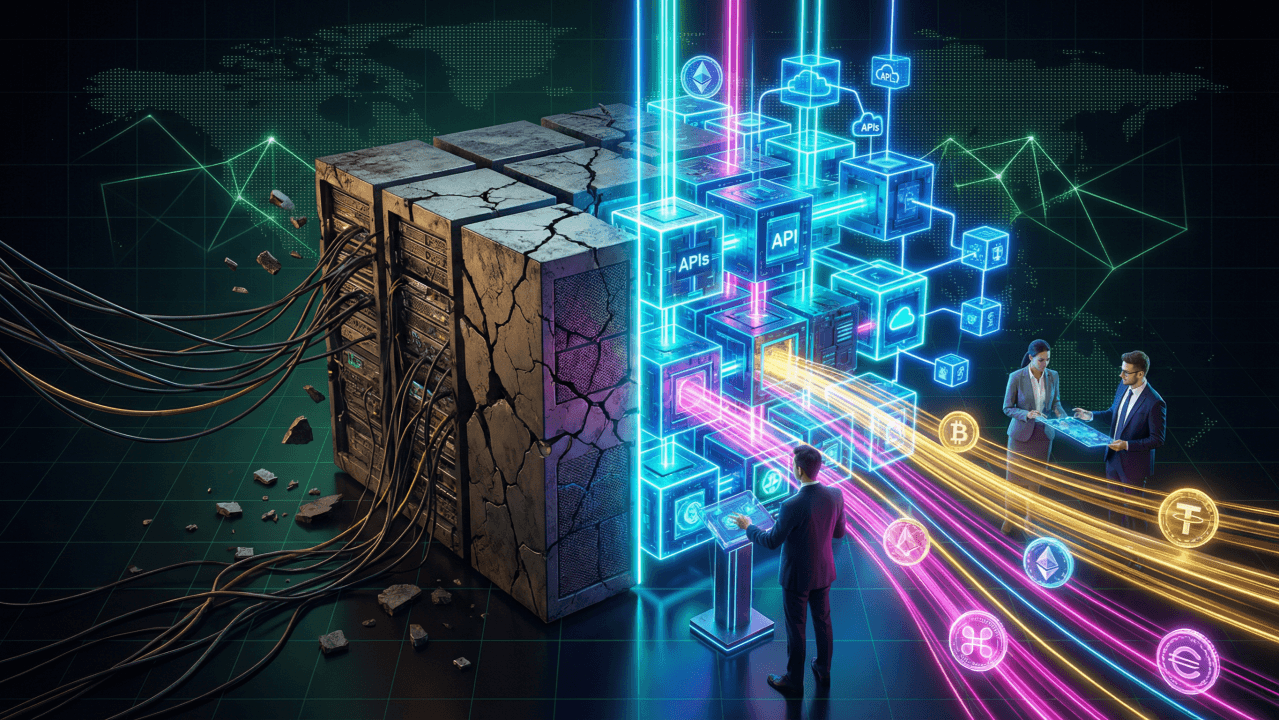
In 2026, we’ll see a clear shift as the industry moves from patching legacy systems to replacing them gradually and deliberately. A well-executed decoupling strategy can make that transition possible without a big-bang replacement.
At WAU, we’re working with organizations that see rethinking architecture as an essential part of infrastructure modernization.
Decouple critical capabilities from the legacy core so older systems can keep running while new features come online in modern layers.
Expose services and processes through APIs, turning rigid internal logic into reusable, scalable, and secure capabilities.
Integrate diverse ecosystems that bring together legacy cores, cloud-native solutions, fintechs, external providers, and new payment rails.
This approach lets organizations innovate while keeping operations running.
Cloud-native platforms are becoming the default for new processors and acquirers for a simple reason. They work. They offer scalability, resilience, security, and flexibility without the fragility of monolithic cores. They deliver the most value when integrated properly with the existing ecosystem.
That connects directly to what we saw in the PSP market in 2025. The most successful companies chose modular architectures connected through well-defined APIs and moved away from trying to build monolithic end-to-end platforms.
The “all-in-one” model is losing relevance because no provider can innovate at the same pace across every layer. Breaking up the stack, decoupling responsibilities, and connecting specialized components is the only practical way to reduce technical debt and shed the burden of legacy systems.
In our experience at WAU, the process extends beyond technology. It requires integration governance, clearly defined API contracts, controlled transition strategies, and above all, an architecture vision aligned with the business.
This structural shift lays the foundation for everything else. Sustaining higher-value capabilities depends on decoupled, integrated, API-driven systems.
2. Data as the deciding factor
Older systems were designed when storing data was expensive, risky, and often unnecessary. In 2026, the opposite is true.
Real-time transaction data is now the most valuable asset in the payments chain. Modern APIs from card networks and cloud-native processors provide unprecedented access to this level of detail.
The impact is immediate. Approval rates rise, fraud management becomes more precise, and operational gains help open up the longstanding “black box” of acquiring.
In corporate treasury, this change addresses a fundamental problem with cash visibility. Many of the challenges we saw in 2025 came from incomplete or delayed information, even when there was enough capacity.
3. Tokenization moves to the center of the business
Tokenization has been around for years, but 2026 will be the year it evolves from a security layer into a driver of revenue and operational efficiency.
Network tokens, issued directly by card networks, improve authorization rates, reduce churn in subscription models, and prepare organizations for a natural convergence of in-person and digital payments. That alone is a significant shift.
A second development is gaining traction and will become more visible in 2026 as stablecoins make their way into traditional financial operations.
Stablecoins are moving beyond their experimental role in crypto to become a new rail for settlement, cross-border payments, and managing value. This is especially relevant where speed, 24/7 availability, and fewer intermediaries are critical.
The biggest change comes when stablecoins become a native part of banking operations.
At WAU, we’re helping institutions integrate stablecoins into their core banking and existing operational systems so they become part of everyday business workflows instead of running on a parallel layer.
Here’s what that involves.
· Integrate stablecoins as another instrument in day-to-day operations alongside traditional accounts, payments, and settlements.
· Connect these digital assets to core systems and to treasury, compliance, and reconciliation systems.
· Enable specific use cases such as international payments, more efficient settlement, or new product models.
When properly integrated, stablecoins complement traditional banking. They extend payments infrastructure, especially where traditional rails are slow, expensive, or limited by operating hours.
This approach also fits naturally with the idea of payments as global infrastructure, where tokenizing payment credentials or value allows for more consistent operations across regions, currencies, and systems.
In 2026, the conversation moves from whether stablecoins will play a role in payments to how to integrate them into the core of the financial business in a secure, regulated, and operationally viable way.
4. Intelligent payment orchestration moves from competitive advantage to baseline capability
The payments ecosystem is increasingly fragmented across A2A, BNPL, stablecoins, digital wallets, local methods, and regional rails.
No merchant can sustain dozens of individual integrations. Intelligent orchestration is becoming the minimum needed to compete across the market.
Highly specialized PSPs and acquirers are leading the way, outperforming generalists by using configurations that adapt to the context and region.
5. Payments as a growth engine
The most important change is cultural.
For years, payments were seen as “plumbing.” In 2026, organizations understand that infrastructure decisions directly affect revenue, loyalty, how quickly they can expand, and the customer experience.
This explains why issuers and acquirers are converging and why neobanks are entering acquiring. Today’s entrepreneurs expect their bank to innovate like a modern fintech. Increasingly, that’s exactly what they’re getting.
The view from WAU
At WAU, this is how we see 2026.
We see a fundamental structural transition, with payments moving from an operational component to a strategic driver of growth. Its impact goes beyond a one-off disruption or a passing technology trend.
We’re seeing firsthand how organizations that decouple systems, integrate capabilities, expose them through APIs, and modernize gradually can move faster, with less friction and a stronger foundation for scaling.
At WAU, we’re ready to support that transition through technology, architecture, integration, and careful execution of changes that cannot afford to fail.
The challenge in 2026 extends beyond adopting new capabilities. It’s about building the infrastructure to sustain them over time.
