
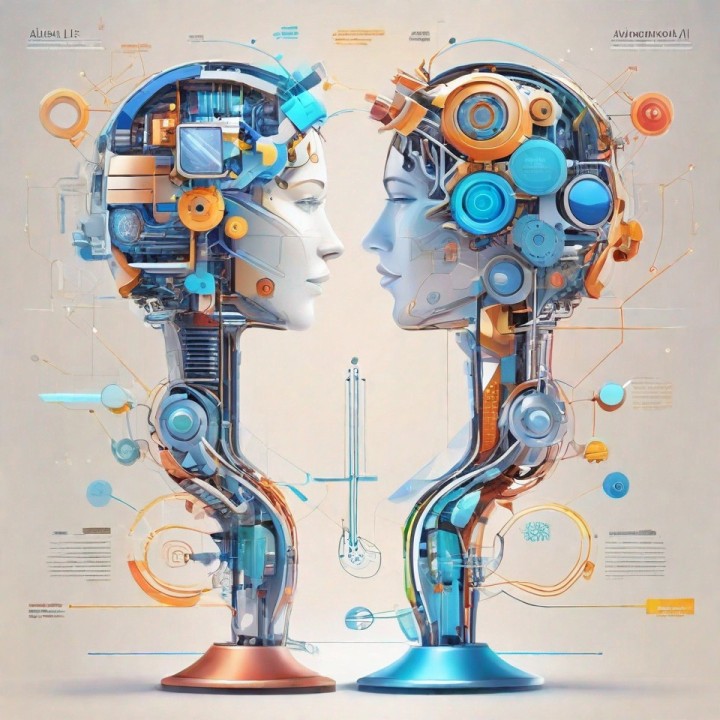
Inteligencia Artificial y Machine Learning, ¿son lo mismo?
In today’s digital era, terms such as Artificial Intelligence (AI) and Machine Learning (ML) have become increasingly common in conversations about technology and advancements in #DigitalTransformation.
In recent conversations with friends and clients, I have often noticed these terms being used interchangeably, which can lead to confusion about their fundamental differences and practical applications.
That is why I decided to explore the distinctions between Artificial Intelligence and Machine Learning in this article, along with some of their main applications across different fields.
Artificial Intelligence (AI)
Artificial Intelligence refers to the simulation of human intelligence in machines, enabling them to perform tasks that would normally require human intervention.
AI encompasses a broad range of capabilities, from speech recognition and computer vision to autonomous decision-making.
In simple terms, AI focuses on creating systems capable of learning, reasoning, planning, and solving problems in ways similar to human beings.
Machine Learning (ML)
Machine Learning is a subfield of AI that focuses on developing algorithms and models that enable computers to learn patterns from large amounts of data and make decisions without being explicitly programmed to do so.
Unlike traditional programming, where specific rules and use cases are defined for each situation, ML algorithms learn from data to improve their performance over time.
Main Applications
Artificial Intelligence
- Virtual Assistants: Virtual assistants such as Siri, Alexa, and Google Assistant use AI to understand and respond to user queries in a natural way.
- Image Recognition: Applications such as facial identification and object recognition rely on AI algorithms to automatically analyze and classify images.
- Autonomous Vehicles: Self-driving vehicles use AI systems to interpret their surroundings, make real-time decisions, and navigate safely without human intervention.
Machine Learning
- Spam Filtering: Email spam filters use ML algorithms to identify and block unwanted messages based on behavioral patterns.
- Personalized Recommendations: Platforms such as Netflix and Amazon use ML algorithms to recommend personalized content to users based on their preferences and past behavior.
- Medical Diagnosis: In healthcare, ML is used to analyze large volumes of patient data and assist in diagnosing diseases by identifying patterns that might otherwise go unnoticed by medical professionals.
Conclusion
In summary, Artificial Intelligence and Machine Learning are interconnected but distinct fields within technology.
While AI focuses on creating intelligent systems that emulate human intelligence, ML concentrates on developing algorithms that learn from data to improve their performance.
At WAU, we have worked on several projects primarily involving Machine Learning, using algorithms that support our clients’ platforms with predictive capabilities—generating results based on historical data and known outcomes—across different industries.
We have also participated in projects that combine ML with Deep Learning to develop AI models for image recognition in marketing campaigns throughout Latin America.
If you would like to explore the world of Artificial Intelligence and Machine Learning in greater depth, don’t hesitate to contact us.
We are here to answer your questions, provide specialized guidance, and help you discover how these innovative technologies can transform your business.
Click here to contact us and discuss how we can help.
