
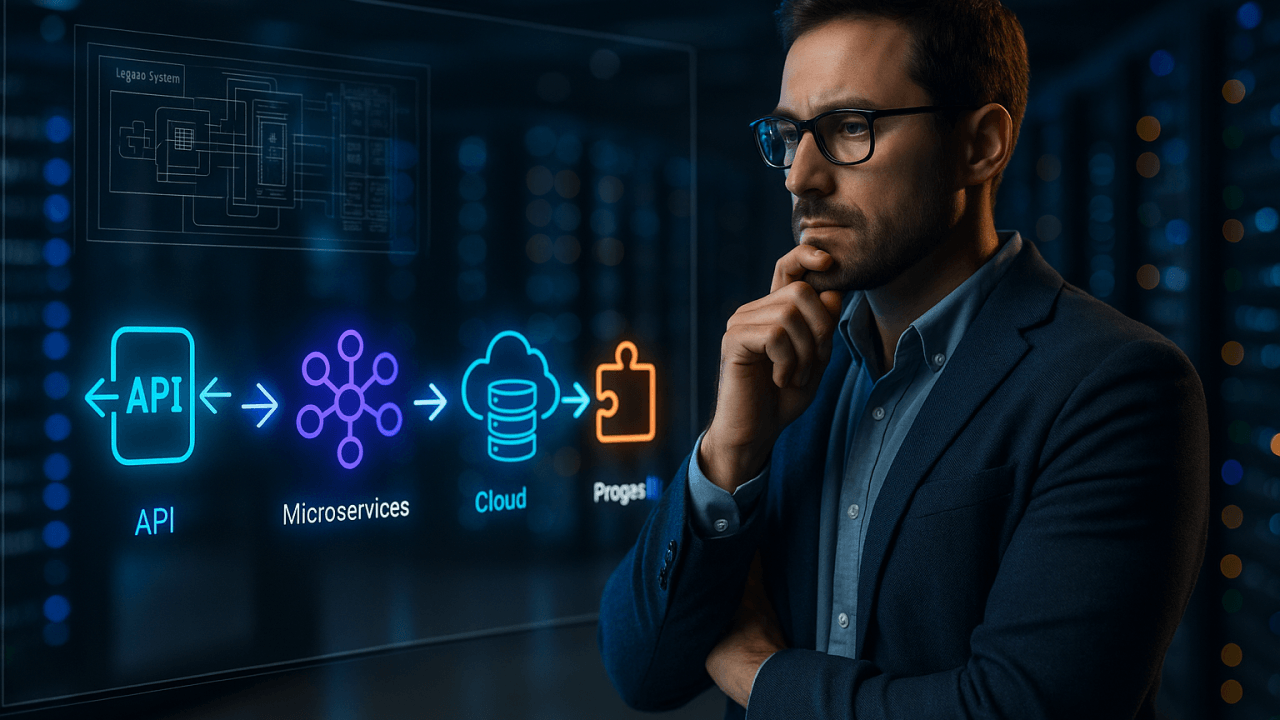
Modernizing Your Entire Core System? It May Be Neither Necessary nor Strategic
One of the most common challenges organizations face with legacy systems is how to modernize while keeping current operations stable.
At WAU, we’ve seen this firsthand. Many of our clients come to us wanting to “modernize everything,” convinced that rewriting their entire core is the only way to be ready for a digital future. That’s rarely the smartest move from a technical, strategic, or financial standpoint.
Our approach starts with your vision. Technology comes later. We start by asking:
Where do you want your business to be in 3 years? Once that goal is clear, we work backward and plan to modernize only what will make a real difference.
The Strangler Fig pattern: how to modernize without disrupting the business
One of the approaches we use most often in these projects is the Strangler Fig Pattern. The principle is simple: build around the existing system and gradually migrate one capability at a time instead of replacing everything at once.
Just as a strangler fig grows around another tree until it replaces it entirely, the new system coexists with the legacy system, gradually wraps around it, and eventually takes over smoothly and without disruption.
How does this work in practice?
In our projects, we use an API gateway as the single entry point for all digital channels. This intermediary layer intercepts every user request and determines whether to route it to a capability that’s already been migrated or handle it through the legacy core.
This lets us:
- Keep the user experience intact.
- Isolate changes in a controlled way.
- Deliver value from the first iteration.
With that foundation in place, we start migrating specific capabilities, prioritizing those with the biggest impact, the lowest complexity, and the closest alignment with the company’s long-term vision.
For example, in one of our financial services projects:
- We migrated the notifications module first, building a modern microservice for push notifications, emails, and alerts from the new backend.
- Next, we tackled the digital payments layer, building an interoperable API that enables new transfer services and connections with fintechs.
- Then we moved on to the reconciliation engine, offloading processing-intensive tasks from the core.
Throughout the project, the legacy system kept running. With every phase, it handled less work and played a smaller role. Eventually, the new system took over completely, and the old system was retired without incident.
Why does this approach work?
It minimizes risk, maximizes returns, and keeps the work moving smoothly.
Every capability you migrate delivers value on its own. There’s no need to wait months or years to see results. Business teams feel the impact from the start, which builds confidence in the process.
It also aligns technology with strategy. Every modernization effort is directed toward building specific capabilities that bring the organization closer to its vision for the future.
Modernizing wisely
At WAU, we firmly believe digital transformation takes technology, vision, and strategy.
Modernizing a core system doesn’t have to be a leap into the unknown. It can be a gradual, measurable, and controlled evolution. When it’s done well, the benefits extend from the backend to business agility, the customer experience, and the ability to innovate.
So let me ask you:
👉 Where do you want to be in 3 years?
👉 What part of your system could you start modernizing this week?
