
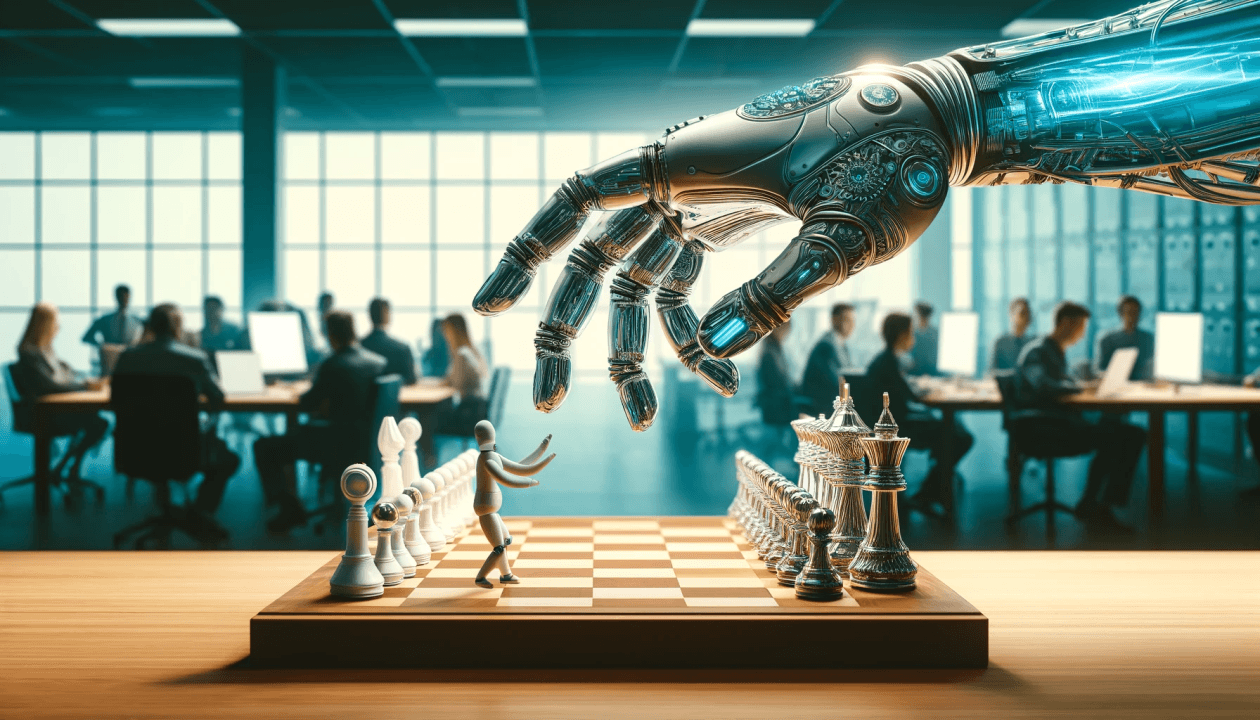
The Future of Work with Artificial Intelligence: Risk or Opportunity?
One of the most widely discussed and published topics today is Artificial Intelligence and the impact it will have on our lives.
Many of these discussions generate considerable fear because of the apocalyptic, Hollywood-style scenarios often associated with AI. One of the most frequently repeated concerns is that #AI will #replace humans in the workplace.
While reading the book Irreplaceable by Pascal Bornet, I came across what I believe is an excellent way to explain why this may not necessarily happen and, more importantly, how we can use AI as a tool to strengthen human resilience and see it as an opportunity to become more fully human.
Below, I’d like to share a summary of an excerpt from the book to further support my argument.
There are three uniquely “human” skills that represent the essence of our humanity: genuine creativity, critical thinking, and social authenticity.
We can observe these abilities in their purest form in children. Aristotle had already highlighted the importance of uniquely human capabilities as the key to a flourishing life.
As we have demonstrated, AI cannot authentically replicate these human abilities. This is because AI lacks several elements intrinsic to these skills: our human experiences, life stories, personality traits, and human emotions, including love.
Therefore, embracing and developing our human abilities enriches our collaboration with AI by complementing its capabilities. This fosters innovation, strengthens relationships, and enables us to solve more complex problems.
These human skills, rather than technical skills, are the skills of the future.
The following matrix summarizes what human skills are and how they differ from AI capabilities.
Article Content – Human Skills and AI Capabilities Matrix
How Does AI Allow Us to Rediscover Our Humanity?
AI Takes Over “Less Human” Tasks
As AI and automation take over mundane and repetitive tasks, such as manual calculations, basic writing, image creation, and data entry, they free us from these tedious activities.
Moving away from these tasks gives us time that we can invest in developing our human abilities.
The More We Excel at Human Skills, the More Value We Create in Synergy with AI
By leveraging our human abilities, we avoid becoming redundant in relation to AI and can truly unlock the potential of this technology.
For example, in healthcare, combining human empathetic understanding with AI-powered data analysis does more than simply add value; it multiplies it, effectively making 1 + 1 = 3.
This synergy between human insight and AI precision not only improves patient care but also drives innovation in treatments.
By strengthening our human abilities, we maximize our potential for synergy with AI, pushing the boundaries of what we can achieve together.
As a Result, AI Encourages Us to Further Develop Our Human Abilities and Become More Profoundly Human
By unintentionally encouraging us to cultivate our most human qualities, AI guides us toward enhancing our humanity.
This profound perspective suggests that AI is not merely a tool for economic productivity but also a means of amplifying our most human traits. It invites us to imagine a world in which, thanks to AI, we prioritize the growth of our inner selves and personal development just as much as economic growth. In a way, AI allows us to rediscover our humanity.
Why Is It Important to Become More Human?
We can lead more #fulfilling lives, rich in #creativity, meaning, and connection.
We can find greater #joy in our work, hobbies, and relationships.
We can also contribute more positively to the world around us by using our unique human qualities to make a difference in the lives of others.
We develop a stronger sense of purpose, aligning our actions with what truly matters to us.
We also become more resilient and better equipped to face challenges and adapt to constant change.
How Can We Develop Our Human Skills?
Further developing our humanity is crucial because it allows us to increase the value we generate when working with AI.
To achieve this, dedicate 15 to 30 minutes each day to exercises that strengthen your human abilities.
Here are some examples you can practice daily:
Foster Creativity: Engage in activities that spark creativity, such as art, writing, or innovative problem-solving.
Embrace boredom by disconnecting from technology, allowing your mind to wander, and stimulating your natural creativity.
Engage in Critical Thinking: Challenge your mind by learning new things, participating in debates, solving ethical dilemmas, or questioning the status quo.
Argue against your own beliefs to broaden your perspective and develop greater open-mindedness.
Cultivate Authentic Relationships: Prioritize face-to-face interactions and build relationships based on empathy and genuine connection.
Greet people on the street, take an interest in what matters to them, and anticipate the needs of others through acts of kindness.
Practice Self-Reflection: Dedicate time to introspection to understand your emotions, motivations, and the impact your actions have on others.
Change your daily routines by doing things such as reading genres you would not normally choose or taking different routes to familiar places.
These experiences can challenge your perspectives and help you better understand yourself.
Conclusion
As we have seen, the potential threat AI poses to our well-being and stability depends largely on the perspective from which we approach and use it.
By intentionally adopting the practices described above, you can strengthen your human abilities and improve your performance while using AI.
With this in mind, we can feel more confident about navigating a world increasingly shaped by artificial intelligence.
The key lies within each of us, in the uniqueness created by our experiences, knowledge, character, and judgment.
It is not about whether AI will control me.
It is about how I will evolve into a better human being who uses Artificial Intelligence as one of the tools available to put my talents at the service of others.
What about you? What are your thoughts on this?
