
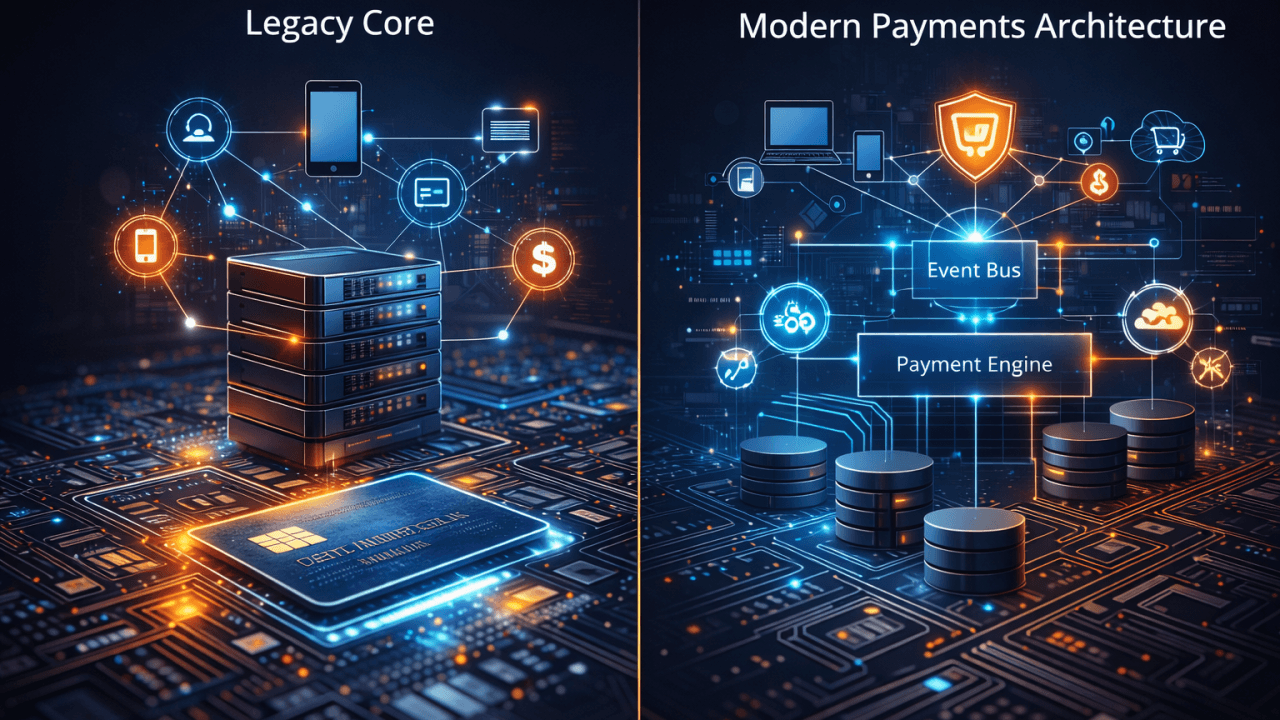
The Real Problem With Digital Payments Isn’t Innovation… It’s Banking Architecture
Over the past few years, we’ve seen a surge in digital payments innovation:
- Real-time payments.
- Digital wallets.
- Embedded finance.
- Open banking.
- Financial APIs that connect entire ecosystems.
Innovation is moving fast. But almost no one is asking an uncomfortable question:
Can banking infrastructure keep up with this new pace?
Behind every instant payment or fintech integration is something that rarely comes up in the conversation: the banking architecture that actually processes those payments.
Many of those systems were designed decades ago.
Digital payments are growing faster than the architecture that supports them
Digital payments have evolved beyond transactions processed at the end of the day.
They’ve become computational events that happen in real time across multiple networks at once.
Those networks include:
- card networks
- ACH transfers
- instant payment systems
- digital wallets
- fintech platforms
- embedded finance APIs
- international networks based on standards such as ISO 20022
In the United States, for example, the introduction of FedNow has accelerated this shift. FedNow is specific to the US market, and similar instant payments initiatives are emerging in several Latin American countries.
Each of these rails has its own:
- operating rules
- settlement times
- risk models
- fraud vectors
Banks are trying to integrate all these systems through API and orchestration layers.
But many banks’ core engines were never designed for this environment.
They were built on very different assumptions:
- batch processing
- linear volumes
- low concurrency
- predictable settlement cycles
Those assumptions no longer hold.
When fraud moves faster than the system
One of the most important changes in today’s ecosystem is speed.
Transactions are moving faster.
So is fraud.
Many traditional fraud detection engines still rely on:
- signals scattered across systems
- post-transaction analysis
- static rules
- data that arrives late
Meanwhile, attackers operate at machine speed.
The result is mounting pressure on financial institutions:
- higher fraud losses
- more false positives
- the need to limit transactions to reduce risk
The system needs to be both faster and smarter.
The quiet challenge of operating multiple payment rails
Payment rails are also becoming increasingly fragmented.
Many banks now operate all of these at once:
- card networks
- traditional transfers
- instant payments
- digital wallets
- fintech integrations
Each has its own settlement and reconciliation logic.
When these systems fall out of sync, problems start to surface:
- accounting discrepancies
- duplicate transactions
- incomplete reversals
- growing exception queues
The implications go beyond day-to-day operations.
In many cases, systems built in different eras struggle to stay consistent over time.
The most common mistake in modernization programs
The same pattern appears in many digital transformation projects at banks.
Banks are modernizing:
- digital channels
- mobile apps
- APIs
- the customer experience
The payments engine powering all of this often stays the same.
It’s like redesigning a car’s dashboard while keeping the same engine.
Over time, this produces architectures with multiple layers:
- APIs
- integration platforms
- orchestration layers
- monitoring
- more integration to connect the layers that came before
The result is growing architectural debt.
The change banks really need
If the payments ecosystem keeps growing at its current pace, the conversation needs to shift from modernization to architecture.
Some of the capabilities we’ll see become established include:
Event-driven architectures
Systems that can process payments as real-time events.
Intelligent multi-rail orchestration
The ability to operate multiple payment networks consistently.
Integrated fraud intelligence
Fraud analysis built into the authorization workflow.
More continuous settlement models
A shift from batch settlement to continuous micro-settlements.
Resilient architectures
High-availability patterns used in other critical industries.
What we’re seeing in real projects
In our work at WAU, we’ve seen that many financial institutions are already facing these challenges.
They’re especially apparent when:
- digital channels expand
- multiple payment rails are integrated
- connections with fintechs grow
- real-time payments increase
In many cases, meeting the challenge means rethinking the entire payments architecture, going beyond adding technology.
That means reviewing areas such as:
- core banking architecture
- payment processing models
- transaction event management
- fraud prevention integration
- orchestration across payment rails
Addressing these elements together makes it possible to build much more resilient platforms that are ready for continued growth in the digital ecosystem.
Final thoughts
Digital payments innovation will keep moving.
In fact, it will accelerate.
Instant payments, open banking, embedded finance, and fintech will continue to expand the financial ecosystem.
That innovation will be sustainable only if the architecture supporting it evolves, too.
The real challenge for digital payments goes deeper than the user experience.
It lies in the infrastructure that makes those payments possible.
Sooner or later, that infrastructure will have to evolve at the same pace as the ecosystem that depends on it.
